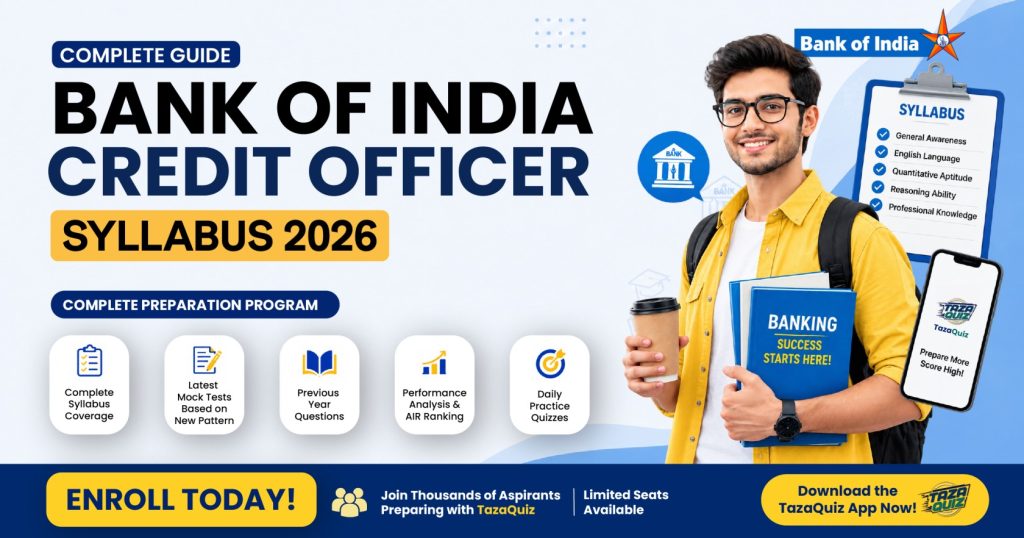
Bank of India has released 514 vacancies for the Credit Officer post, and along with it, the revised exam syllabus that every applicant needs to study closely. Since this is a specialist role, the exam doesn’t just test general aptitude, it also checks how well you understand credit, lending, and banking concepts. This article breaks down the Bank of India Credit Officer Syllabus 2026 section by section, in plain and simple language, so you know exactly what to study and where to focus your time.
Before you dive in: a syllabus this detailed is much easier to manage with regular practice tests. Taza Quiz offers free mock tests for bank exams, helping you check your preparation level as you go worth trying alongside your study plan.
Exam Pattern Overview
The Bank of India Credit Officer exam is a single online test with no separate sectional timing meaning you can manage your own time across all four sections as you see fit within the total duration.
- Total Questions: 150
- Total Marks: 150
- Total Duration: 120 minutes (2 hours)
- Question Type: Objective (MCQ)
- Mode: Online
The Professional Knowledge section carries the single largest share of marks, which makes it the biggest deciding factor in your final score and shortlisting.
Section-Wise Question Distribution
| Section | Number of Questions | Marks |
| English Language | 25 | 25 |
| Reasoning Ability | 25 | 25 |
| Quantitative Aptitude | 25 | 25 |
| Professional Knowledge | 75 | 75 |
| Total | 150 | 150 |
Notice that Professional Knowledge alone makes up half the total marks. Candidates coming from a banking, finance, or commerce background will naturally have an edge here, but with focused study, anyone can build a strong footing in this section.
English Language Syllabus
This section checks your grammar, vocabulary, and reading comprehension skills needed for everyday professional communication in a bank job.
- Reading Comprehension (often based on banking, finance, or economy-related passages)
- Cloze Test
- Error Spotting and Sentence Correction
- Fill in the Blanks (single and double blanks)
- Para Jumbles
- Sentence Improvement and Phrase Replacement
- Vocabulary – synonyms, antonyms, and word usage
Reasoning Ability Syllabus
This section tests your logical thinking and how quickly you can solve pattern-based problems.
- Puzzles (floor-based, box-based, scheduling)
- Seating Arrangement (linear, circular, square)
- Syllogism (basic and coded)
- Inequality
- Coding-Decoding
- Blood Relations
- Direction Sense
- Order and Ranking
- Input-Output
- Logical Reasoning (statement-based questions)
Quantitative Aptitude Syllabus
This section measures your calculation speed and accuracy with numbers.
- Simplification and Approximation
- Number Series
- Quadratic Equations
- Data Interpretation (tables, bar graphs, line graphs, pie charts, caselets)
- Arithmetic topics: Percentage, Ratio & Proportion, Profit & Loss, Simple & Compound Interest, Time & Work, Time-Speed-Distance, Averages, Mixtures & Allegations, Partnership
- Basic Number System concepts (LCM, HCF, divisibility)
English, Reasoning, and Quant together carry 75 marks the same weight as Professional Knowledge alone. That means you can’t afford to ignore them. Practising timed sets on Taza Quiz can help you build both speed and accuracy across all three sections.
Professional Knowledge Syllabus (Most Important Section)
This is the section that decides most of your final score, so it deserves the biggest share of your preparation time. It covers real, job-relevant credit and banking topics:
Banking & Financial System
- Structure of the Indian banking system
- Role and functions of RBI, commercial banks, and NBFCs
- Types of bank accounts and deposit products
Credit Appraisal & Lending
- Credit appraisal process and the loan lifecycle
- Types of loans retail, MSME, corporate, agriculture
- Fund-based and non-fund-based credit limits
- Security, collateral, and guarantees
Financial Statement Analysis
- Reading and analysing Balance Sheets
- Profit & Loss account interpretation
- Cash Flow and Fund Flow statements
- Ratio analysis (liquidity, profitability, leverage)
Working Capital & Project Finance
- Working capital assessment methods (Turnover Method, MPBF)
- Project appraisal and viability analysis
- Break-even analysis and DSCR (Debt Service Coverage Ratio)
Risk Management
- Credit risk, market risk, and operational risk
- Basel norms and capital adequacy requirements
- Risk mitigation techniques
Asset Quality & Recovery
- NPA classification and provisioning norms
- SMA categories and loan restructuring
- SARFAESI Act and recovery mechanisms
Priority Sector & MSME Lending
- RBI’s priority sector lending guidelines
- MSME classification and financing schemes
- Government credit-linked schemes
Regulatory & Compliance
- RBI’s lending and exposure norms
- KYC and AML compliance basics
Preparation Tips
- Start with Professional Knowledge since it carries the most weight and build your basics in credit and lending concepts first.
- Don’t neglect English, Reasoning, and Quant together they equal Professional Knowledge in marks.
- Since there’s no sectional time limit, decide your own time-per-section strategy in advance and stick to it during the exam.
- Practice full-length mock tests regularly to get used to switching between sections smoothly within 120 minutes.
Preparing for a specialist officer exam means balancing four very different sections in one sitting general aptitude and technical banking knowledge. Download the Taza Quiz app to practice both, track your progress with free mock tests, and walk into the exam hall with a clear idea of where you stand.
FAQs
Q1. How many questions are asked in the Bank of India Credit Officer exam?
The exam has 150 objective-type questions, carrying a total of 150 marks.
Q2. What is the total duration of the BOI Credit Officer exam?
Candidates get 120 minutes (2 hours) to complete the entire test, with no separate time limit for individual sections.
Q3. Which section carries the highest weightage in the exam?
Professional Knowledge carries the highest weightage 75 out of 150 marks making it the most important section for shortlisting.
Q4. Is there a sectional time limit in this exam?
No, there is no sectional time limit. Candidates can distribute the total 120 minutes across sections as per their own strategy.
Q5. What topics are covered under Professional Knowledge?
It covers banking and financial systems, credit appraisal and lending, financial statement analysis, working capital and project finance, risk management, asset quality and recovery, priority sector and MSME lending, and regulatory compliance.

Related Posts

179 सरकारी नौकरियाँ: 10वीं पास वालों के लिए सुनहरा मौका!
179 सरकारी नौकरियों का बंपर मौका: CCRUM Recruitment 2026 में…

UP Police SI भर्ती: 5.31 लाख अभ्यर्थी हुए शामिल, परीक्षा संपन्न
📋 विषय सूचीमुख्य समाचारपृष्ठभूमिपरीक्षा के लिए जरूरी बातेंअन्य महत्वपूर्ण सरकारी…

DDA माली रिजल्ट 2026: 282 पदों पर चयनित हुए उम्मीदवार, देखें पूरी मेरिट लिस्ट!
DDA माली रिजल्ट 2026: 282 पदों पर चयनित हुए उम्मीदवार,…
